
How Skipper Works
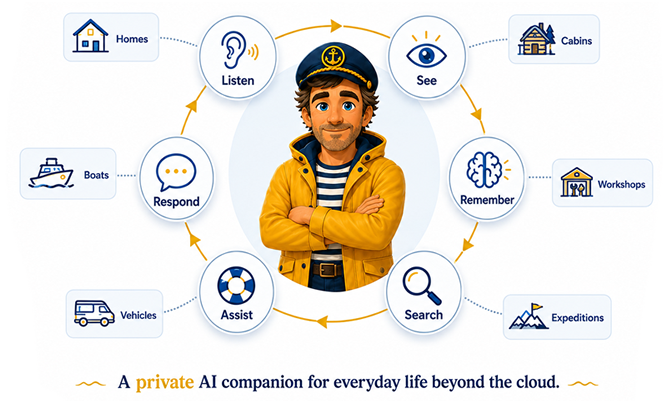
Skipper is a self-contained system made from several pieces of hardware and software working together as one assistant.
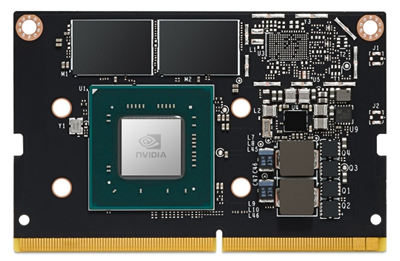
The Jetson module is mounted on a carrier board, which serves a role similar to a small computer motherboard. It provides connections for displays, cameras, USB devices, storage and other supported hardware.
Rather than sending questions and personal information to an online AI service, Skipper performs its primary processing directly within the local system. Its AI workloads are hardware accelerated to provide responsive performance within a compact, low-power platform.
One system, several connected parts
Skipper is not an application that simply runs on a phone, but it is not quite a conventional robot either.
Perhaps the closest comparison is a robot head and brain. It has eyes, ears, a voice, memory and additional senses, but it does not need legs or wheels to be useful.
The central unit can be connected to microphones, speakers, displays, cameras, storage and other supported devices. Each component gives Skipper another way to communicate with the user or understand the surrounding environment.
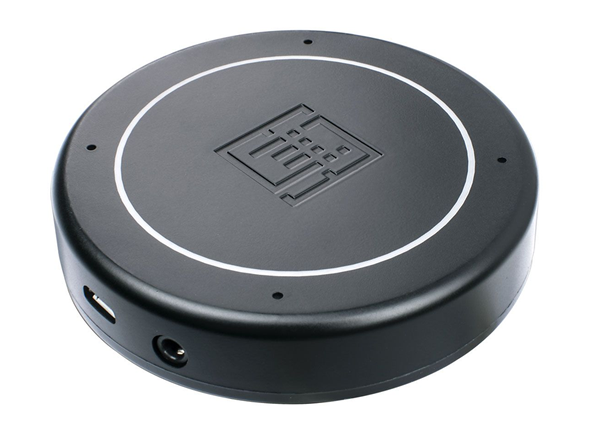
Because voice is one of Skipper’s primary forms of interaction, the current system uses a four-microphone array based on the XMOS XVF3800 platform. It is designed to improve voice capture in noisy environments and supports features such as USB and I²S operation, 360-degree far-field pickup and onboard acoustic processing.
A connected display provides chat, system controls, visual feedback and access to stored information.
Cameras allow Skipper to detect activity and recognise familiar objects. Reminders, schedules and supported sensors can also provide information about events or changing conditions.
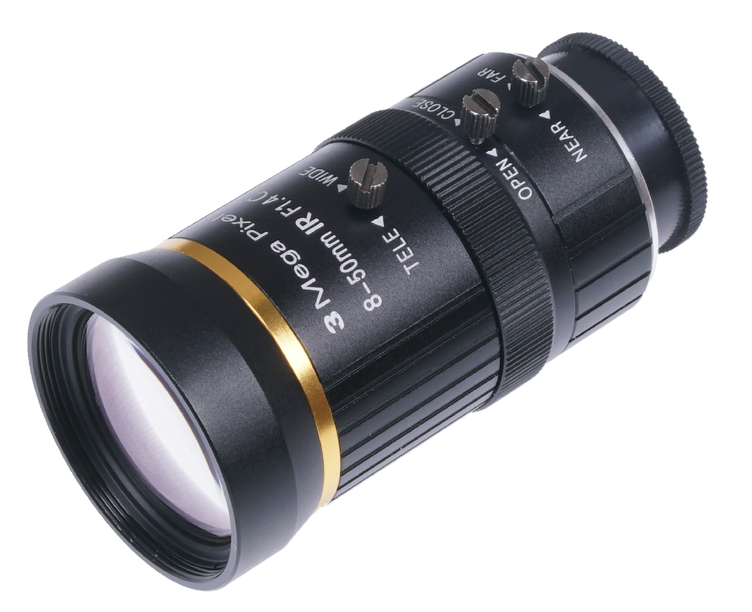
The current system uses two cameras connected directly to the Jetson platform for fast image transfer. A presence camera handles functions such as motion detection, light and colour changes, basic pattern recognition and user-presence awareness. A second HD camera uses a higher-quality lens for visual recognition tasks where image quality is more important than speed.
The exact combination of components can vary depending on where Skipper will operate and which features are required.
Installed as a dedicated assistant
Skipper is designed to be installed as a complete, purpose-configured system rather than downloaded as a general application for an arbitrary computer.
It is not simply a software package. It is an integrated assistant platform in which the hardware, voice system, cameras, sensors, interface, knowledge and personality are designed to work together.
The central unit can be placed in a suitable protected location and connected to the required power supply and accessories. Microphones, speakers, displays and cameras can then be positioned where they are most useful.
Once installed and configured, Skipper operates as a local assistant within that environment. Users can communicate through voice or chat, search stored knowledge, receive reminders and alerts, and use the visual or proactive features included in the installation.
Local knowledge and intelligence
Skipper’s knowledge is stored within the system.
Manuals, procedures, recipes, reference documents, facts and other useful information can be added so that Skipper can search, explain and discuss them without depending on an internet connection.
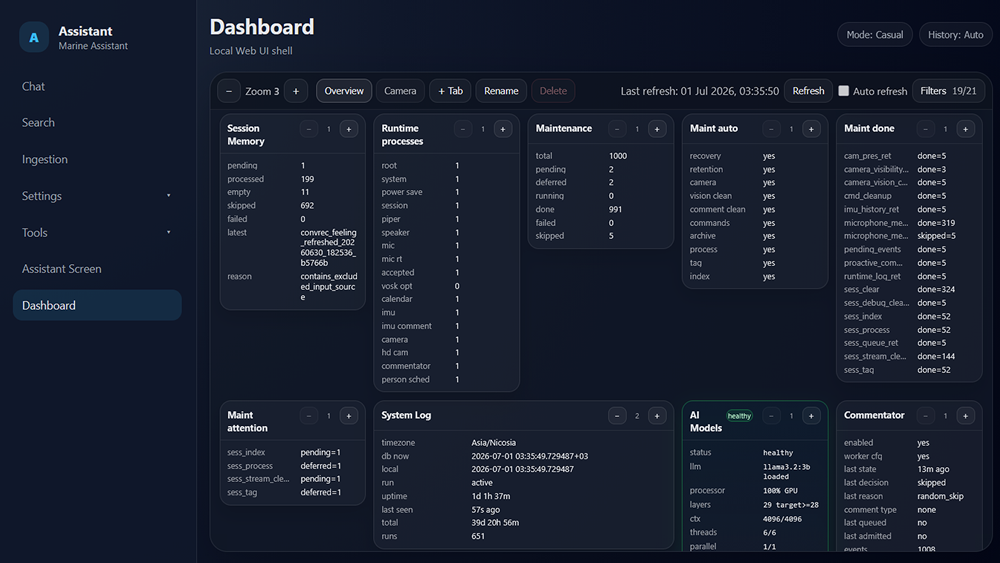
Skipper can be monitored and configured through a locally hosted web interface. This interface can be reached over Wi-Fi or a wired network connection using a normal web browser.
For example, a user can connect to Skipper’s local Wi-Fi access point, open the local web address and manage the system without requiring an external internet service.
Skipper’s memory, preferences and settings are also stored locally. This allows the assistant to retain useful information and adapt its behaviour while keeping the user in control of the data.
Designed for low-power operation
One of the main reasons Skipper was built around the NVIDIA Jetson Orin Nano platform is its balance between AI performance and power consumption.
While much of the AI industry focuses on running increasingly large models on increasingly powerful hardware, Skipper was developed in the opposite direction, to achieve useful local intelligence within a carefully controlled power and memory budget.
The system can simultaneously run a large language model, speech recognition, text-to-speech, embedding models, databases, camera processing, image recognition, a hardware-accelerated 3D interface and the locally hosted web interface.
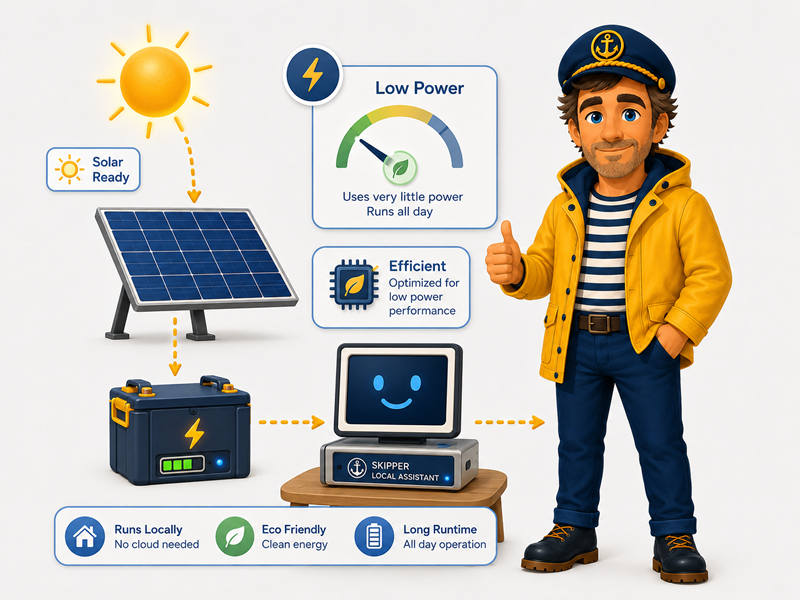
It performs these tasks within an 8 GB unified-memory system and, in its current configuration, remains below approximately 25 watts at peak operation.
Based on the measurements from the present system, the core platform can idle at roughly 6–7 watts, although the final total depends on connected displays, speakers, cameras and other accessories.
That places its power consumption within the general range of a modern phone charger, despite the number of services operating simultaneously.
Low-power operation was important from the beginning because Skipper was intended to work in locations that may depend on batteries, solar charging or other limited energy sources.
Independent by design
Skipper does not require a continuous internet connection or an external cloud-based AI service for its core operation.
Once the system and its local knowledge have been prepared, its main features continue to operate independently. This makes Skipper suitable for boats, remote properties, workshops, vehicles, field installations and other environments where privacy, reliability and independence are important.
In simple terms, Skipper is not just software running quietly in the background.
It is a dedicated combination of intelligence, knowledge, memory, voice, vision and hardware brought together as one practical assistant.